Automated Control Cabinet Wiring for Electrolyzers
Research Project Shows New Approaches to Flexible Cable Handling
The industrial manufacturing of electrolysers is a key component in the ramp-up of the hydrogen economy. High-performance electrolysers are needed to meet Germany’s demand for green hydrogen. However, while demand for such systems is rising, their production has so far been heavily labor-intensive. As part of the “FertiRob” research project, which is part of the H2Giga flagship project, the Chair of Production Systems at Ruhr University Bochum is collaborating with numerous partners to develop solutions for automated series production. A key focus is on automated control cabinet wiring, which is one of the most challenging assembly steps in the entire process.
Complex Requirements for Automation
The wiring of control cabinets places high demands on automation technology. This is due to the properties of the materials being processed: flexible cables behave in ways that are difficult to predict, tend to twist, and make reliable simulation challenging. At the same time, they must navigate tight installation spaces with numerous potential collision points.
Added to this is the high degree of variation. Control cabinet solutions are often custom-designed and do not follow a standardized layout. Traditional automation solutions, which are designed for repeatable processes, quickly reach their limits here. Instead, a high degree of flexibility is required, coupled with maximum process reliability.
The existing manufacturing methods for electrolyzers also contribute to the complexity. Since they have evolved over time, many systems are not designed for automated assembly. The project therefore worked in parallel on a more automation-friendly design to create the conditions for cost-effective mass production.
Innovative Solution with Two Robots
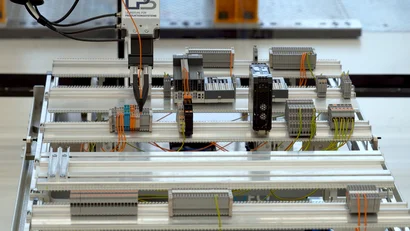
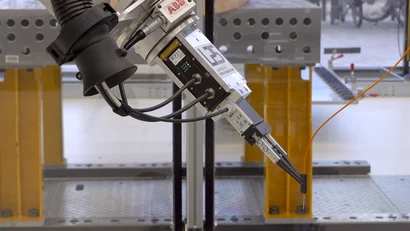
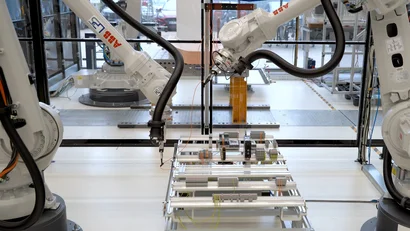
The solution developed in the project is based on the use of two robots, each equipped with a GEP2000 series small-part gripper. They handle the precise gripping, positioning, and insertion of the cables into the corresponding terminals.
A key difference from traditional approaches lies in the system’s design: Instead of a conventional mounting plate, a wiring frame is used. This provides better accessibility and facilitates flexible handling of the cables. In addition, the solution allows for the wiring of both cable ends, which represents a decisive advantage over many existing automation concepts.
The goal of the development was to reduce complexity as much as possible without limiting the necessary flexibility. The result is a robust yet adaptable process that enables automation even in applications with a wide variety of variants.
Precision and Force Control as the Key to Success
The GEP2000 series grippers play a central role in the application. They were specifically selected for their technical characteristics: compact design, high positioning accuracy, sufficient opening stroke, and integrated force control.
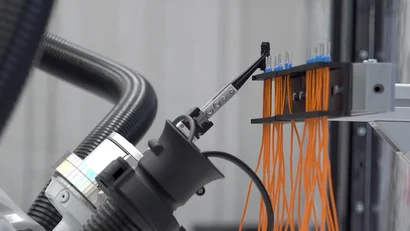
The latter, in particular, offers decisive added value in cable handling. When laying the cable, the force control ensures that it can be precisely tensioned at one end while being guided along its length inside the control cabinet. In this way, the cable can be precisely positioned, and the insertion process into the terminal can be made process-reliable.
The solution also proved effective when integrated into the existing system environment: Via IO-Link, the grippers could be seamlessly integrated into the robot controller. Parameterization was carried out using the existing infrastructure, which significantly reduced the integration effort.
Rapid Implementation and High Adaptability
Another key factor in the project’s success was the close collaboration between research and industry. The required grippers were provided on short notice and could be thoroughly tested during a three-month trial phase. Several sizes were available, which could be optimally adapted to the application on-site.
In addition to technical requirements, economic factors also played a role. The combination of high performance, suitable geometry, and attractive terms—particularly in the context of a research project—was a decisive factor in the selection of the components.
Paving the Way for Series Production
The project impressively demonstrates how even highly complex manual processes can be optimized through intelligent automation solutions. The developed application reduces process complexity while simultaneously increasing the quality and reproducibility of control cabinet cabling. In doing so, it makes an important contribution to the industrialization of electrolyzer production and, consequently, to the development of a high-performance hydrogen economy.