Automated Sample Handling in the Laboratory
How the REP2000 Parallel Rotating Gripper Efficiently Automates Manual Decapping and Recapping Processes
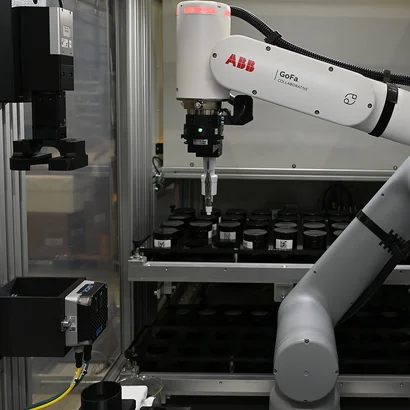
In a laboratory setting, precision, repeatability, and process reliability are crucial. At the same time, there are still numerous steps that are performed manually—especially when a wide variety of sample vessels must be handled. The German Reference Office for Proficiency Testing and Reference Materials (DRRR) faced precisely this challenge: The opening and subsequent resealing of sample vessels needed to be automated to make sample preparation more efficient and reproducible. ABB Robotics, in cooperation with Zimmer Group, developed an automation solution for this purpose, in which the REP2000 2-jaw parallel-rotating gripper plays a central role.
Automating Manual Processes in the Laboratory
In this specific case, sample vessels had to be reliably opened and resealed in what is known as the decap/recap process. The difficulty lay not only in the actual rotational movement but, above all, in the variety of a total of seven different types of sample vials.
Added to this were varying process conditions: The vials had to be handled safely even under different temperature conditions. It was therefore clear that a solution was needed that operates both flexibly and precisely and can be seamlessly integrated into the automation environment.
Gripping and Rotating in a Compact Module
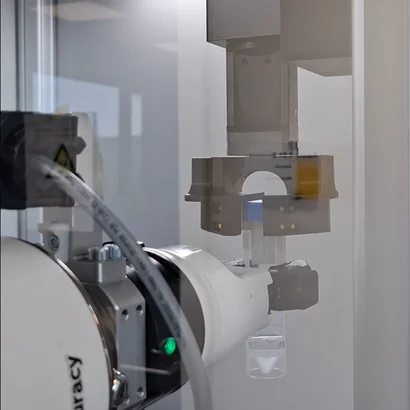
Zimmer Group’s REP2000 was selected for this application. The electric 2-jaw parallel rotary gripper combines gripping and rotating in a compact module, making it particularly suitable for applications where available installation space is limited and multiple motion functions need to be consolidated into a single unit.
This approach offers decisive advantages, particularly in a laboratory setting: Instead of designing multiple components separately for gripping and rotating movements, both functions can be implemented in a single, space-saving solution. This not only reduces the complexity of the setup but also simplifies the design of the overall system.
Another important consideration for the DRRR application: The REP2000 operates electrically and therefore requires no compressed air supply. This facilitates integration into sensitive laboratory environments and reduces infrastructure requirements.
Precise Control for Different Vessel Types
A key factor in selecting the gripper was, in particular, the ability to control it via an interface. The REP2000 can be flexibly configured via IO-Link. This allows, among other things, the stroke of the gripper jaws, the gripping force, and the angle of the continuously rotatable unit to be adapted to the specific application.
This flexibility was essential in the laboratory application for safely opening and resealing the various sample containers. The system operates with torque control: The ABB Robotics robot adjusts the movement of the sample containers during opening and closing—depending on the thread profile, pitch, and rotational speed. This ensures that the process is both reproducible and gentle.
The finely tuned controllability of the electric solution really shines, especially with containers featuring different closure geometries and varying conditions.
Process reliability even for sensitive handling tasks
In addition to flexibility, process reliability was also a key criterion. The REP2000 features mechanical self-locking in the event of a power failure. This prevents workpieces from being damaged in the event of an unexpected power failure. For laboratory applications where samples must be held securely, this feature is crucial.
Additionally, an integrated emergency release allows the gripper to be opened when de-energized, enabling workpieces to be safely removed if necessary. Such features enhance operational safety and support robust system operation.
In terms of service life, the module is designed to meet industrial requirements: The REP2000 achieves up to 5 million maintenance-free cycles. Other standard features, such as integrated sensing, adjustable gripping force, positioning capability, and continuously adjustable motion parameters, underscore its suitability for demanding automation tasks.
Compact, powerful, and easy to integrate
The fact that the project was implemented despite integration hurdles underscores the practicality of the overall concept and the performance of the rotary gripper used. From the user’s perspective, four characteristics in particular were decisive in choosing the REP2000:
- no compressed air required
- compact design
- outstanding performance
- user-friendly digital interface
It is precisely the combination of electric control and the compact integration of gripping and rotating functions that makes the REP2000 an attractive option for laboratory and handling processes where precision, flexibility, and a small footprint are required.
Successful implementation with high customer satisfaction
The project demonstrates how manual processes in sample preparation can be efficiently replaced by tailored automation solutions. With the REP2000, a solution was created that reliably opens and reseals sample vessels of various designs.
The collaboration was also rated positively. A representative from the application team stated: “The collaboration with Zimmer was smooth and unproblematic. The customer is very satisfied with the solution,” said Willi Tyroke, Senior Project Engineer at ABB Robotics.
The implementation of the automation solution for the German Reference Office for Proficiency Testing and Reference Materials (DRRR) demonstrated how even demanding sample-handling processes can be automated cost-effectively and with process reliability using an electric, adjustable gripping solution.