Multiple Functions in a Single Component
Semi-Standard Electric Parallel Rotating Gripper Simplifies End-of-Line Inspection
In automated quality inspection, every second determines a system’s cost-effectiveness. At the same time, demands for flexibility and process reliability are constantly increasing. stoba also faced this challenge when developing a modular system for automated inspection and handling solutions. In an end-of-line inspection station, a complex injection-molded part was to be inspected using camera-based technology. To do this, the workpiece had to be gripped precisely, rotated at high speed, and its position reliably monitored at all times—with a cycle time of just three seconds and in continuous 24/7 operation.
Multiple Functions in a Compact Unit
The requirements for the handling unit were correspondingly high. The goal was to find a solution that combined the secure gripping of components with varying diameters, a rotary drive capable of up to 800 min⁻¹, signal transmission, and position feedback into a single, highly compact assembly. “It was crucial for us that the solution could be easily integrated both electrically and on the software side. At the same time, with a cycle time of just three seconds, we had to ensure high dynamics and process reliability,” said Luis Baumhackl, the automation engineer responsible at stoba.
Standard solutions on the market could only meet these requirements with limitations or only partially. Often, several individual components would have been necessary—with correspondingly higher space requirements, greater integration effort, and additional interfaces. “When designing the test station, we had to reconcile high dynamics, limited installation space, and different component variants. It was precisely this combination that made the task particularly challenging from a technical standpoint,” adds Thomas Leuthold, design engineer at stoba.
REP2000 Combines Gripping, Rotation, and Monitoring
“The real problem was that we couldn’t implement the gripping and rapid rotation functions even with classic standard solutions. That’s why we had to decide whether to develop our own solution or whether something suitable was already available on the market. Zimmer Group was the only supplier that responded immediately to our inquiry and offered us a solution,” Leuthold continues.
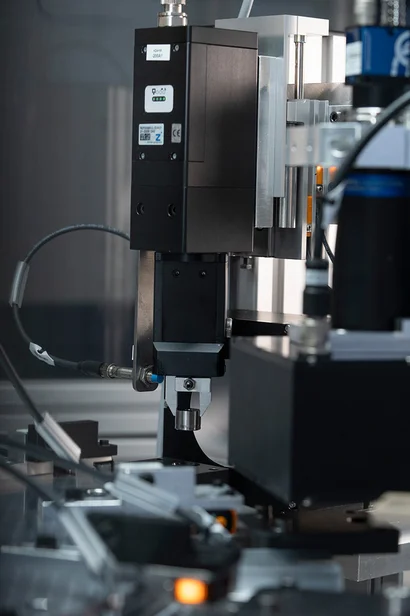
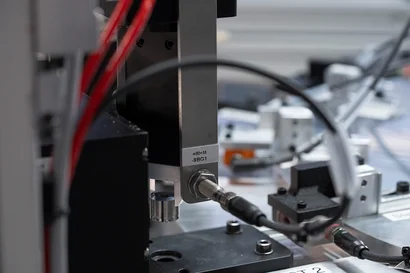
With a custom-adapted semi-standard model based of the REP2000 electric 2-jaw parallel rotary gripper, Zimmer Group was able to combine all the required functions into a single integrated solution. The gripper enables flexible gripping of components with varying diameters while simultaneously handling the highly dynamic rotational movement of the workpiece. In addition, the gripper’s position can be continuously monitored, which provides additional process reliability.
A key advantage for stoba was the compact design. This allowed the parallel rotary gripper to be integrated into the test station without complex design modifications. Variable adjustment options for the gripping range and rotational speed also ensure a high degree of flexibility when handling different component variants.
The integrated control architecture was particularly impressive.
All relevant operating parameters can be set directly via the gripper’s programmable IO-Link interface. Luis Baumhackl reflects on the integration: “The integrated control architecture and the IO-Link connection significantly reduced the integration effort. This allowed us to implement a compact solution that operates stably in 24/7 operation, even with short cycle times.”
Working Together on Customized Further Development
A particular challenge was further developing the parallel rotary gripper to meet the required high rotational speeds. In close collaboration between stoba and the development specialists at Zimmer Group, the solution was specifically optimized. The goal was to combine the required rotational speeds of up to 800 min⁻¹ with high dynamics and reliable continuous operation.
This collaborative partnership played a decisive role. Early in the project, Zimmer Group developed a concrete technical proposal and closely supported its implementation through to series production. This ensured that both the ambitious schedule and the high technical requirements were reliably met.
The solution is also impressive from the plant manufacturer’s perspective. Particular emphasis is placed on Zimmer Group’s strong focus on finding solutions and its willingness to jointly further develop the standard gripper for this specific application.
“What was remarkable was their strong willingness to offer us a suitable solution right from the first meeting and to enter the discussion immediately with a concrete technical proposal,” said Maik Schäfer, Head of Applications at stoba, regarding the collaboration. “Both the demanding timeline and the technical requirements were handled transparently, quickly, and reliably at all times. Other suppliers were unable to offer us a comparably compact solution, nor were they willing to further develop their standard solution accordingly.”
High Dynamics for Short Cycle Times
The result is a high-performance, compact handling solution that combines all process steps into a single unit. Thanks to its high dynamics during acceleration and deceleration, as well as rotational speeds of up to 800 min⁻¹, the system achieves a cycle time of just three seconds. At the same time, the electric parallel-rotating gripper ensures stable and reliable operation during continuous 24/7 use.
With the REP2000, Zimmer Group demonstrates how multiple handling functions can be intelligently combined into a single component. This reduces integration effort, increases process reliability, and opens up new possibilities for machine builders to implement highly dynamic automation tasks in a cost-effective and space-saving manner.
About stoba:
stoba is an internationally active technology partner for the development, manufacturing, and assembly of precision components, assemblies, and systems. Since its founding in 1961, stoba has been supporting its customers in implementing innovative solutions where existing standards reach their limits. Its strength lies in the combination of engineering expertise, industrial manufacturing excellence, and a strong commitment to innovation. With more than 1,000 employees, over 600 machines, approximately 70,000 square meters of production space, and a research and development budget of six percent, the company manufactures more than 100 million components and assemblies annually for customers around the world.